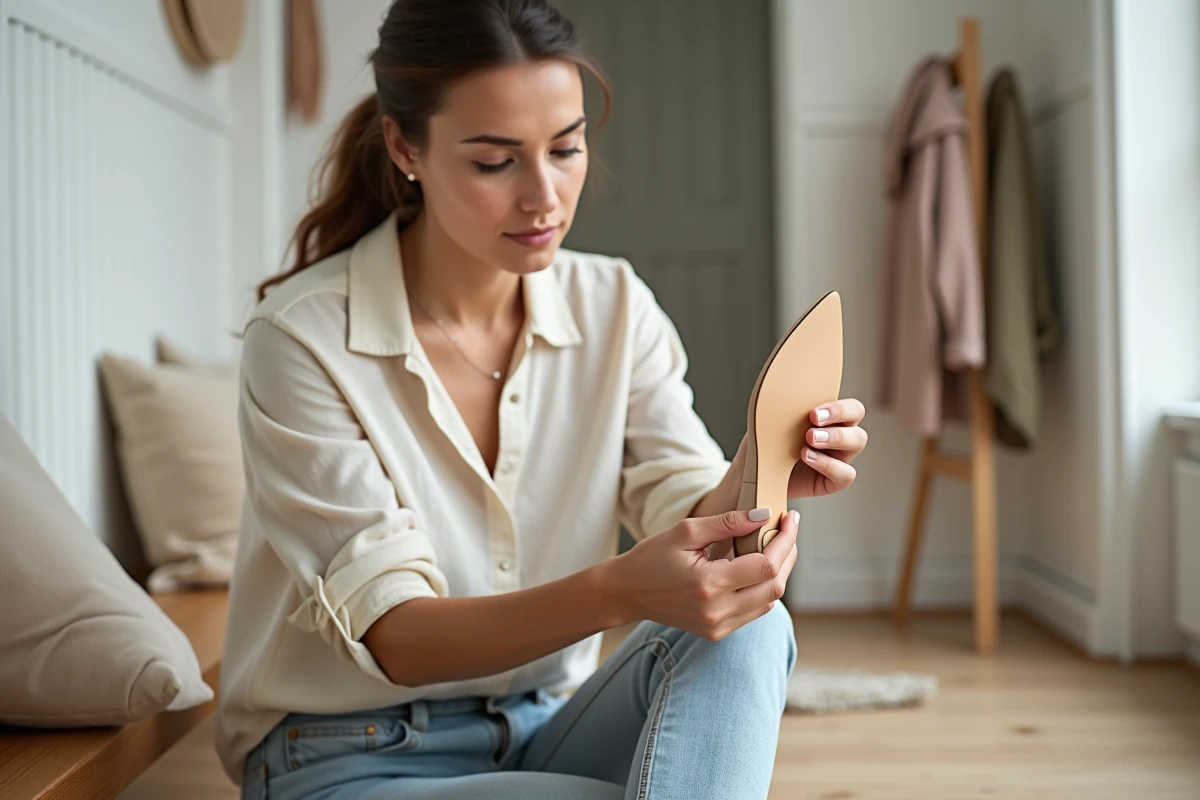
A too-large high heel shoe does not only pose a comfort issue. The foot slides forward with each step, altering the support and creating friction on the heel and toes. Pumps and heeled sandals are the most affected models, as their fit leaves little room to compensate for a size discrepancy.
The challenge is to reduce the excess space without altering the shoe’s silhouette. Adjustment accessories come in several categories, but not all are suitable for high heels, and some become visible on open or cut-out models.
Specific constraint of heels: why classic tricks are not enough
Wearing thick socks or padding the toe with cotton works on sneakers or derby shoes. On a pump, these methods pose two problems: they alter the aesthetic and they push the foot backward without holding it laterally.
On a heel over five centimeters, the foot naturally tips forward. If the fit is too long, the forefoot ends up against the toe, while the heel lifts with each step. The result: blisters at the Achilles tendon, compressed toes, and an unstable gait.
Finding solutions for too-large heeled shoes therefore requires working on several areas of the foot simultaneously, not just the overall volume.
Gel half-soles and anti-slip patches: invisible adjustment under the forefoot
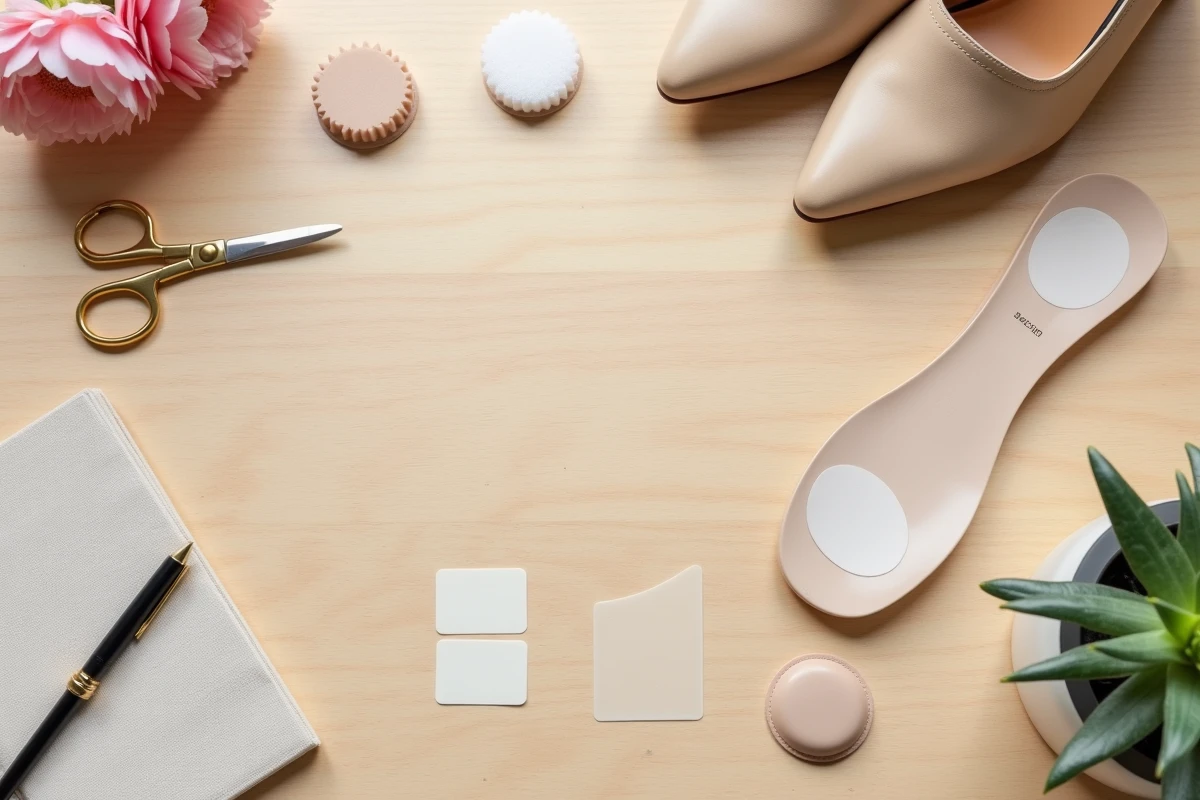
Transparent gel half-soles stick under the forefoot, inside the shoe. Their thickness reduces vertical space and prevents the foot from sliding toward the toe. The gel also cushions the pressure on the sole, which limits fatigue when wearing high heels for several hours.
Anti-slip patches work on a similar principle. They come in the form of thin adhesive strips, often made of textured silicone, and are placed under the metatarsal area. Their main advantage on open heels: they remain almost invisible, even on an open-toe pump.
Limitations to know before buying
These accessories compensate for a half-size discrepancy, sometimes a full size on closed-toe models. Beyond that, the support becomes insufficient, and the heel continues to lift.
- Check that the adhesive is compatible with the shoe’s interior material (leather, synthetic, fabric) to avoid it peeling off after a few hours
- Prefer anatomical half-soles, slightly curved under the arch, rather than flat models that slide under the foot
- On strap sandals, test the half-sole with the strap tightened to the maximum, as it changes the foot’s position in the shoe
Heel cushions and retaining pads: securing the foot without crushing the back
The heel cushion is a piece made of foam or gel that sticks inside the back counter. It reduces the diameter of the opening and prevents the foot from rising with each step. On a classic pump, a good cushion eliminates the friction responsible for blisters at the Achilles tendon.
Self-adhesive pads work similarly but cover a larger area. Some extend up to the instep and provide lateral support that a simple heel cushion does not offer.
Choose based on the type of pump
A pump with a rigid counter better accommodates a thick cushion than a model with a soft edge. On mules or cut-out pumps, the cushion should remain thin to avoid protruding from the visible edge of the shoe.
Memory foam offers an interesting compromise: it compresses under the pressure of the foot and returns to its volume at rest, which extends its lifespan compared to a classic gel that eventually flattens.

Shoe repair: the durable option for a significant size discrepancy
When the difference exceeds a full size, removable accessories reach their limits. The foot remains poorly secured, and stacking half-soles, cushions, and patches creates discomfort different from what was intended to correct.
A cobbler can intervene on the very structure of the shoe. The most common alterations on heels include reducing the back counter by sewing, adding a custom insole that conforms to the shape of the foot, and installing internal lateral reinforcements.
On quality models (full-grain leather, stitched construction), these interventions preserve the shoe’s silhouette. On shoes with glued synthetic structures, the cobbler’s margin for maneuver is more limited, and the result is less predictable.
Reversibility: a criterion often overlooked
Feedback from specialized forums shows that users seek reversible solutions, especially on expensive pairs. An adhesive cushion can be removed without leaving a trace on patent leather. A reduction stitch, however, permanently alters the fit.
Before entrusting a pair to a craftsman, it is useful to first test removable accessories for a few days. If the support remains insufficient despite the combination of half-sole and cushion, structural alteration becomes the next logical step.
Compatibility with open pumps and heeled sandals
Open models (open toe, side cut, mule) pose an additional constraint: any visible accessory betrays the adjustment. Transparent silicone patches remain the most discreet solution, provided you choose a matte model rather than a shiny one, which catches the light.
- On a mule, only the cushion placed under the support band can act without being visible from the outside
- On an open-toe pump, the half-sole must not extend beyond the area covered by the leather, lest it create a visible bulge
- On a fine-strapped sandal, the only truly invisible option is the anti-slip adhesive strip glued under the insole, at the forefoot level
The choice of accessory depends as much on the shoe model as on the size discrepancy. A closed pump tolerates a slightly thick cushion. An open sandal only allows for the strict minimum. Adapting the solution to the type of heel, rather than applying a one-size-fits-all recipe, remains the best way to achieve a discreet and stable fit.